One Announcement Rewrites Three Decades of PlayStation Product Logic
On July 1, 2026, Sony Interactive Entertainment published a announcement under 300 words on the PlayStation Blog: starting in January 2028, physical disc production will be discontinued for all new games releasing on PlayStation platforms. The post was written by Sid Shuman, Sony Interactive Entertainment's Senior Director of Content Communications, who wrote: "physical game disc production for all new games releasing on PlayStation consoles will be discontinued starting January 2028" — a sentence that countless outlets would go on to quote verbatim, and the starting point of this entire controversy.
The wording of the announcement is considerably more measured than most of the headline interpretations that followed. The boundaries it draws are clear: games released before January 2028, or already confirmed for physical release, are unaffected — disc-drive consoles already in players' hands, existing disc libraries, and the used-game market will all continue operating as before. What actually changes is limited to "new games released after that date." As for whether PlayStation games will still appear on retail shelves after 2028, Sony left that open — the announcement mentions it will "continue to offer players the choice to purchase at retail or on PS Store," but whether that means "a box containing a download code" or "a card printed with a redemption code" was left unspecified. That ambiguity later became a focal point pressed by outlets like Game File.
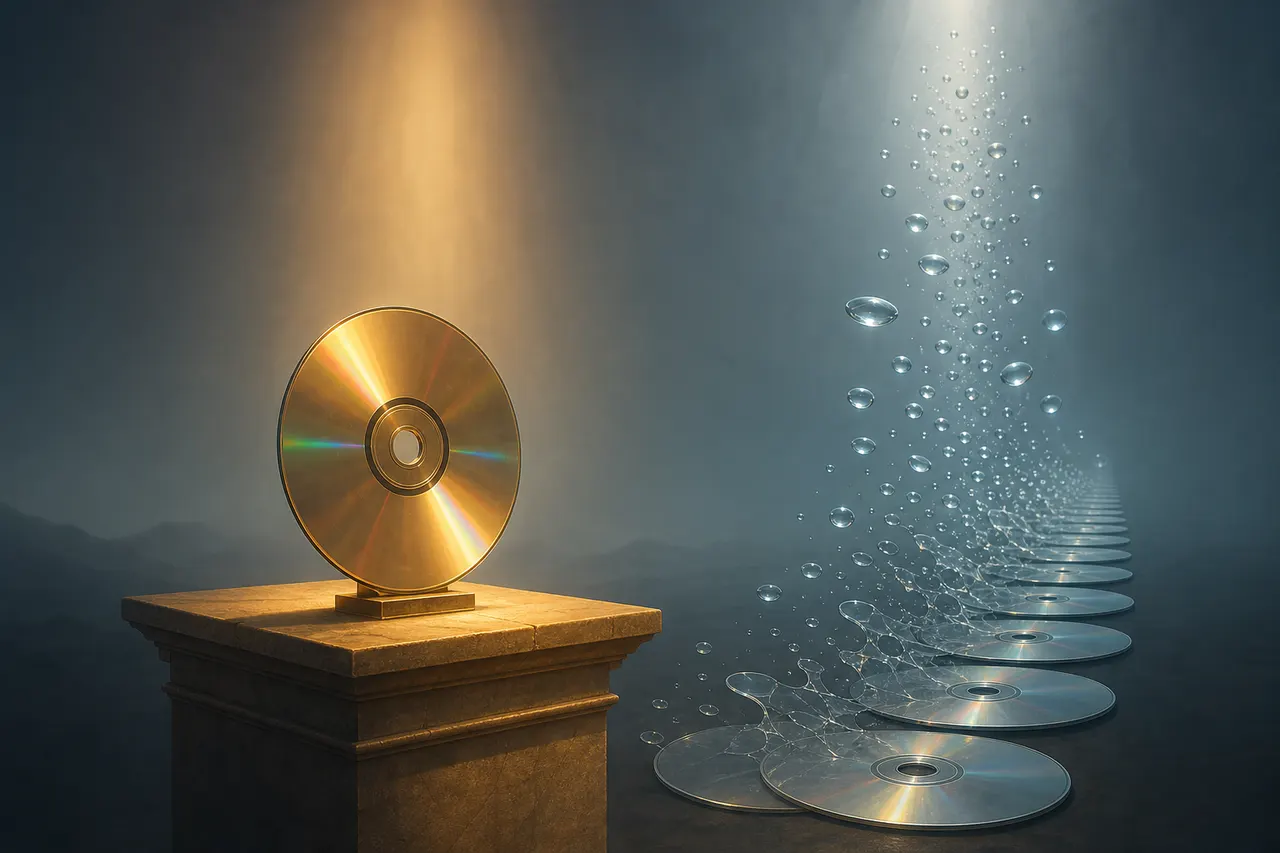
Discs Were Once Sony's Weapon Against Nintendo — Now Sony Is Taking Them Away Itself
What stings most about this news isn't digitization itself — it's that Sony is dismantling the very thing that built its business. In 1994, the original PlayStation used cheap CD-ROMs to undercut Nintendo's cartridges, driving prices down and reshaping the console market's balance of power. Square, the developer behind Final Fantasy VII, once ran an ad mocking that if the game had shipped on cartridges, "the retail price would have been $1,200."
At E3 2013, Sony humiliated a rival again with a 21-second clip. At the time, Microsoft planned to restrict used-game trading and digital sharing on the Xbox One; on stage, a Sony executive handed a disc to a colleague, who simply said "thanks." The video went on to rack up over 20 million views on YouTube and became the defining meme of that year's E3.
Thirteen years later, it's Sony's turn to be mocked. In the petition she launched, Jade Pearce, CEO of Canadian independent game retailer PNP Games, nearly quoted that history verbatim: "At E3 2013, Sony won over an entire generation of gamers by promising you could resell, lend, and 'keep forever' the games you bought — and by publicly mocking a competitor for trying to restrict those rights. Thirteen years later, it's Sony taking all of that away."
Officially "Following Preference" — Analysts Are Reading a Different Ledger
Sony's stated reason in the announcement boils down to a single sentence: consumer preference has shifted decisively toward digital media, away from physical discs. There's data behind this — according to the most recent fiscal year figures disclosed in Sony's investor relations filings, nearly four-fifths of full-game purchases for PS4 and PS5 titles are digital (the exact percentage varies slightly across Chinese- and English-language coverage; this article was unable to directly verify Sony's original financial report PDF, but "close to 80% digital" is the consensus range across reports). Other reports note that physical discs now account for just 3% of total revenue in the PlayStation games segment.
But Ampere Analysis analyst Piers Harding-Rolls, interviewed by Game File, laid out a more concrete ledger — at least three practical considerations behind the announcement: eliminating roughly $1 in disc production and logistics costs per game copy; dropping the disc drive to make next-gen consoles cheaper to build — echoing what then-Xbox head Phil Spencer said back in 2024, that the disc drive is "the only consumer electronics component that still ships with a moving drive," with a shrinking supplier base and real cost pressure; and going fully digital reduces the risk of games leaking ahead of release while effectively eliminating the used-game market, pushing more players toward buying new.
Bloomberg's Jason Schreier put it more bluntly in his reporting: his understanding is that Sony's internal calculus is that the digital user base is now large enough to absorb some attrition; margins are about to get fatter; and players will complain, but will most likely still pay up in the end. The official line talks about "choice"; the industry analysis talks about "profit." That gap is one source of players' anger.
The Trigger: GTA VI's "Physical Edition" Doesn't Actually Include a Disc
The week before Sony's announcement, it emerged that GTA VI — billed as "the biggest release of the decade" — would ship its so-called physical edition box not with a disc, but with a download code. That detail had already ignited player anxiety about "physical collecting disappearing," so when Sony's announcement followed a week later, many outlets read it not as an isolated decision but as "the industry's biggest platform formally ratifying a trend that was already underway."
250,000 Signatures, Sony's Silence, and Retailers Speaking Out
The same day the announcement dropped, PNP Games' Jade Pearce launched a "Don't Kill the Disc" petition on Change.org. It passed 40,000 signatures within 48 hours, topped 100,000 by day four, and stood at 213,022 when media reported on it on July 8, before subsequent coverage put it past 250,000 in the following days. According to Push Square's tally, at least 15 similar petitions went live on Change.org around the same time, launched by people in Portugal, the Netherlands, the UK, the US, Denmark, and Switzerland, among other places.
Sony's official social media response was silence. PlayStation's X account went nearly a week without posting after the announcement. When it finally resumed, the post it chose had nothing to do with the controversy — a promotional post for the "FlexStrike" wireless controller — which was immediately flooded with roughly 65,000 replies, almost uniformly negative and mocking the silence.
Retailers weren't quiet either. GAME, a chain retailer operating in Spain, posted on X: "Regarding the recent news: our silence ends here. To those who love video games, it's time to defend what we truly care about... Digital and physical could have coexisted — in fact, they already have, for years." Independent retailer VGP's reaction was more blunt: "Oh f**k!" — publicly worrying that Microsoft might follow suit. Among players, several anecdotes circulated: one person said they tried to cancel their PS Plus subscription in protest, only to be "retained" with a 50%-off renewal offer, which many found darkly ironic; others dug up data showing physical sales accounted for 54% of UK sales of Marvel's Spider-Man 2, challenging Sony's claim that "consumers have already abandoned physical."
Digital Ownership vs. Rental — Sony Just Made It Explicit
What this controversy really touches on is a more fundamental question: is a digital game you paid for actually "yours"? When Game File pressed Sony for clarification, a Sony spokesperson gave an unambiguous answer: "For all digital content, including games, movies, and music, what players purchase is a license for personal, non-commercial use only." This marks the first time Sony has directly confirmed that a digital purchase is, in essence, a license — not ownership.
There's already legal precedent bearing on this. California's AB2426, which took effect in 2025, prohibits game publishers selling digital content in California from using the word "sell" in ways that mislead consumers, when what's actually being sold is a "revocable license" rather than the game itself. Players' distrust isn't unfounded, either — Sony has previously "removed" purchased movies from users' digital libraries due to licensing changes, an episode that keeps resurfacing as evidence that digital purchases can be unilaterally clawed back. On the longer-term concern of game preservation, Sony's response is that it will "remain committed to bringing past PlayStation experiences to new generations of hardware," through emulation and remasters — but it has made no preservation commitment whatsoever for new games released after 2028 that lack a physical backup.
Not a Word on Whether PS6 Will Have a Disc Drive
The biggest open question left by this announcement concerns the rumored PS6. Ampere Analysis' Piers Harding-Rolls told Game File it's "essentially certain PS6 won't launch before 2028," and that "the base PS6 model won't include a physical disc drive." Sony itself has disclosed nothing about PS6's release timing or whether it will support an internal or external disc drive.
Push Square outlined three possible directions: selling a standalone external Blu-ray drive, as it did with the PS5 Pro; launching a trade-in program letting players swap their existing discs for digital redemption codes; or simply abandoning backward compatibility with the physical game library built up over more than a decade, leaving anyone who still wants to play old games to hold onto their PS4 or PS5. All three remain speculation for now — Sony has not commented on any of them.
Sony Is Already Dismantling Its Disc Factories
Sony's actual actions speak louder than its statements. The Sony DADC disc plant in Thalgau, Austria — which has manufactured 24 billion discs over its history — is now being converted into an optical microlens lab. These microlenses are used in automotive headlight road projection, AR/VR devices, fiber-optic networks, and medical devices. Markus Streibl, head of Sony DADC's micro-optics division, confirmed the company has invested roughly €30 million in new equipment for the conversion. The plant currently produces 600,000 discs a day, about half of them PlayStation games; according to Sony DADC, its roughly 300 existing employees won't be laid off, but retrained and shifted to microlens production. More telling still, reports indicate the plant's microlens trial production dates back as far as 2024 — meaning the transition was already quietly underway more than a year before the public announcement.
No Reversal So Far — Just One Concession That Isn't Really a Concession
Facing overwhelming backlash, the only adjustment Sony has privately made to publishers is this: after January 2028, partners will still be allowed to "reprint" physical PlayStation disc copies of games that were already released before January 2028, but any game newly released after that date will remain digital-only. Some outlets have framed this as a "loosening window," but it's more accurate to describe it as a clarification of the policy's boundaries — not a walkback of the decision.
Industry analyst Dr. Serkan Toto put it plainly: "Sony is not going to reverse this decision." He believes Sony knew exactly what the online reaction would look like before the announcement went out, and that "it's just waiting for this storm to pass" — with PlayStation Plus's roughly 50 million subscribers giving Sony more than enough cushion to absorb a "loud but not large" group of dissenters.
Worth noting for comparison: Sony isn't a company that has never backed down on similar issues. In 2021, Sony likewise announced it would shut down the digital stores for PS3 and PS Vita; facing player backlash, then-President of Global Business for PlayStation Jim Ryan publicly admitted within a month that "it's clear that we didn't get this one right," and reversed the decision. But most analysts don't expect history to repeat this time: closing the storefront for an aging console and abandoning disc production entirely involve entirely different orders of magnitude in cost structure, used-game market logic, and margin arithmetic.
As of now, Sony has made no further public commitment or adjustment regarding the January 2028 timeline. The petition with 250,000 signatures keeps growing, and retailers like GAME continue speaking out publicly — but the €30 million in equipment Sony has already poured into the Thalgau plant is already up and running.